
Homeowner's Guide to Siding in Edmonton
The right materials, how much it costs to side a home in Edmonton, and how to choose a contractor
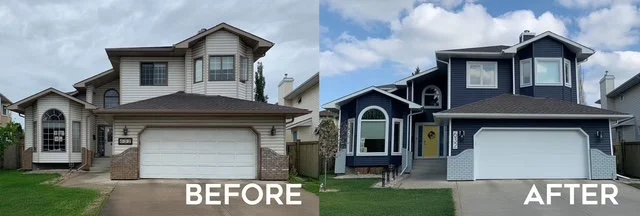
Most homeowners in Edmonton don’t have a ton of siding knowledge. And why would you? You don't do siding... that's our job.
So we figured the right thing to do is to give you the knowledge you need to make an informed decision, without the pressure of having a salesperson in your home.
What Topic Interests You Most?
The Best Siding Products for Edmonton Homeowners
Vinyl Siding
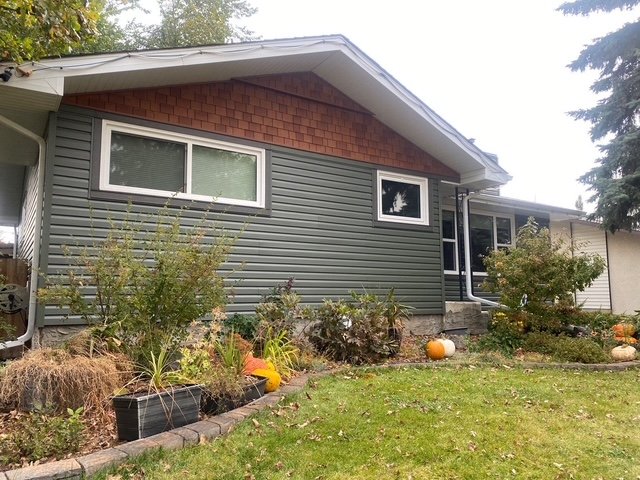
If a house in Edmonton was built in the past 30 years, there’s about a 70% chance it was built with vinyl. That’s because vinyl siding (aka PVC siding) has been the standard siding in Edmonton for new build homes since the early 1990s.
Here are the reasons that vinyl siding has been number one in Edmonton for so long:
Price
Vinyl siding is the least expensive siding option in Edmonton. Lightweight and inexpensive to manufacture, vinyl costs less to purchase and is easier to install than most other siding options. Vinyl siding comes in two basic price bands:
(1) The lighter colors of vinyl siding (white, beige, and soft yellows, grays, and blues) are the least expensive.
(2) Dark or premium colours of vinyl siding come in at a higher price than the lighter colors - please see our cost of siding a house in Edmonton guide at the bottom of this page for more detailed info.
Maintenance
Vinyl is virtually maintenance-free. Routine maintenance for this product typically involves nothing more than washing it down with a garden hose to clean the dirt off every couple of years. No paint or staining needed!
Longevity
Barring things like hail, fire, or unusual UV exposure, vinyl siding lasts about 25 years on the wall in Edmonton without needing to be replaced. The first generation of vinyl siding products seems to reach the end of its lifespan between the 25 to 30 year mark.
Despite being the go-to siding product for the Edmonton market for so long, vinyl is not without its limitations. Here are a few things to think about before choosing to re-side with vinyl in Edmonton:
Curb Appeal
Having been popular in the Edmonton area for so long, it can be tough to create a truly unique exterior with vinyl siding. If it’s important for you that your home’s new exterior stands out from your neighbour’s, your contractor will have to come to the table with some options to help with material selections and design.
Combustibility
Vinyl siding provides no protection against fire, and melts almost immediately when exposed to direct flame.
Heat / UV Exposure
Vinyl siding can have issues when placed near areas of high heat, such as barbecues. There are many cases of vinyl siding melting due to reflections from their neighbours’ high-performance windows.
So You’ve Decided On Vinyl Siding… Now What?
If you've settled on vinyl siding as the product of choice for your renovation, the next thing to figure out is which manufacturer’s products you prefer. Blue Jay Exterior Renovations install vinyl siding from 3 manufacturers:
● Royal Building Products
● Mitten Siding
● Gentek Building Products
There are other manufacturers and product lines available in the Edmonton area, but we stick with these three. Other manufacturers don’t offer the same product availability and support, warranty reputation, or customer service as our main three.
Most homeowners don't have a strong preference between vinyl manufacturers, so they will leave it up to the contractor to select the manufacturer and then the homeowner will pick colors and type from there.
If you do have a preference among the manufacturers, let your contractor know right away. Pricing will vary slightly from supplier to supplier, so the choice of product line will have an impact on the bottom line.
Want to learn more about vinyl siding in Edmonton? You can check out our vinyl siding page for more information by clicking here
James Hardie Fiber Cement Siding (Hardie Board)
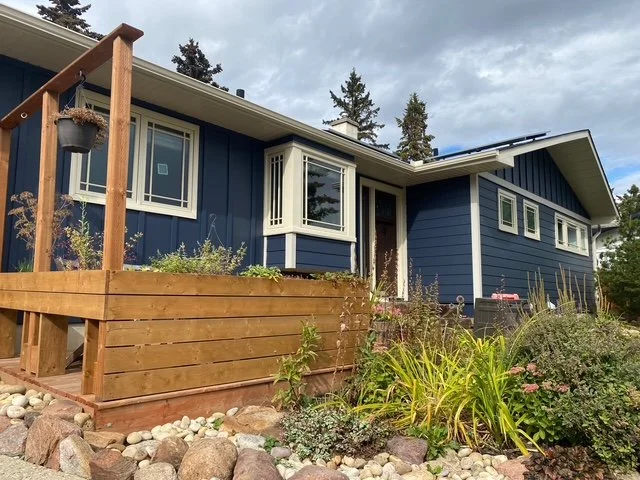
Fiber cement siding has once again been ranked as one of the top projects by return on investment for home improvement projects (ratings compiled by Remodelling Magazine in the 2023 Cost vs. Value report). House hunters, home builders, and realtors all see value in a fiber cement exterior.
Fibre cement was invented in 1899 by an Austrian named Ludwig Hatschek. The original formulation of “fibrocement” used asbestos to add flexibility and workability to the durability of Portland cement.
But then James Hardie Building Products changed the original formula in the 1980s when they invented the first asbestos-free fiber cement. Today, James Hardie’s fiber cement is a durable composition of cement, sand, cellulose fibers (aka wood pulp) and water.
Also referred to as Hardie board or Hardie siding, James Hardie Building Products is the largest fiber cement siding manufacturer in the world. The popularity and use of Hardie siding in Edmonton has exploded over the past 10 years. All of Hardie’s siding products are made from their proprietary fiber cement formula.
As a company, James Hardie has been around for over 125 years and has built a very strong brand. So much so that somewhere between 80% and 90% of all the fiber cement siding installed in North America in a given year is manufactured by James Hardie. Here’s how they manage to stay ahead of their competitors, year in and year out:
Curb Appeal
With standard 7"-wide plank reveals and a natural wood-look, HardiePlank lap siding has a classic visual appeal. This is why you’ll often find it in estate and higher-priced neighborhoods. Re-siding with Hardie in Edmonton allows your home to stand out.
Durability
James Hardie manufactures a siding product line that’s designed specifically for the Alberta climate. They use a weather chamber in their in-house research lab to determine the best composition for the base material, and they’re constantly making adjustments to improve their products. James Hardie produces house siding that can withstand hail, rapid freeze & thaw cycles, and high UV exposure during our long summer days.
Non-Combustibility
Fiber cement is rated non-combustible, meaning that it will not smoke or burn when exposed to heat or flame. Simply put, it can help to protect your home in case of a fire outside of your home. There have been several local examples where a James Hardie home stood strong beside a vinyl home that was destroyed due to fire.
Longevity
With a 30-year non-prorated warranty, Hardie stands behind their product. No other siding in Edmonton can offer the same lifespan as James Hardie.
Engineered Wood Siding
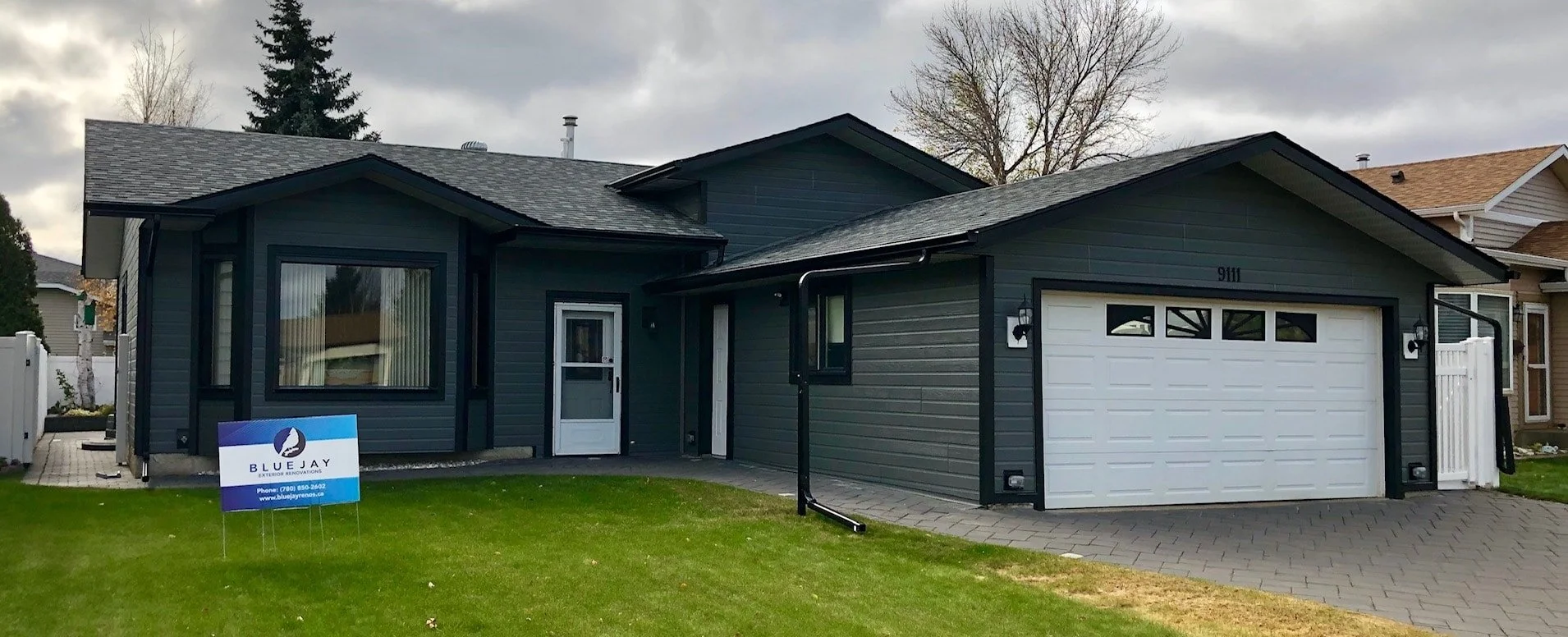
Canexel Siding
Canexel is a wood composite product manufactured by Maibec, with a similar look to James Hardie. Canexel has been used in the Edmonton market for decades and carries with it a strong brand name and a good track record of performance.
The product has a number of advantages that has led to its enduring popularity in the Edmonton market.
Curb Appeal – Featuring a deep, authentic wood grain, Canexel mimics the look of cedar siding better than fiber cement.
Proven Performance – Canexel has been used in the Edmonton market for over 15 years, and has proven its ability to stand up to our rapid freeze/thaw cycles and long summer days.
Weight – Relative to fiber cement, Canexel siding is lighter and thus easier to carry. If you are planning to install yourself, this could be a consideration.
Other Engineered Wood Siding
There are two other engineered wood siding product lines available in Edmonton – KWP Eco Side and Nature Tech. Both are wood-based siding products that have only been available in Alberta for just a few years.
The products are manufactured in Quebec, and have a decent track record in that climate, but given how much tougher the Alberta climate is, we recommend waiting a few more years to see how it performs here. (EDIT: As of November 2024, KWP Engineered Wood Siding products are no longer being manufactured, and are not available. Yet another case of a new product that didn’t last for the long haul!)
Louisiana Pacific manufactures the Smart Side line of engineered wood siding. Smart Side is made from wood chips glued together, much like OSB plywood panels. Smart Side has been performing well for decades in Minnesota and other colder US climates, so we have no doubt that it can be a good solution in Edmonton as well.
The only downside is that Smart Side has only just recently become available in Alberta, and it’s almost exclusively a special order product: this increases cost and lead-times.
Wood Look Siding Products
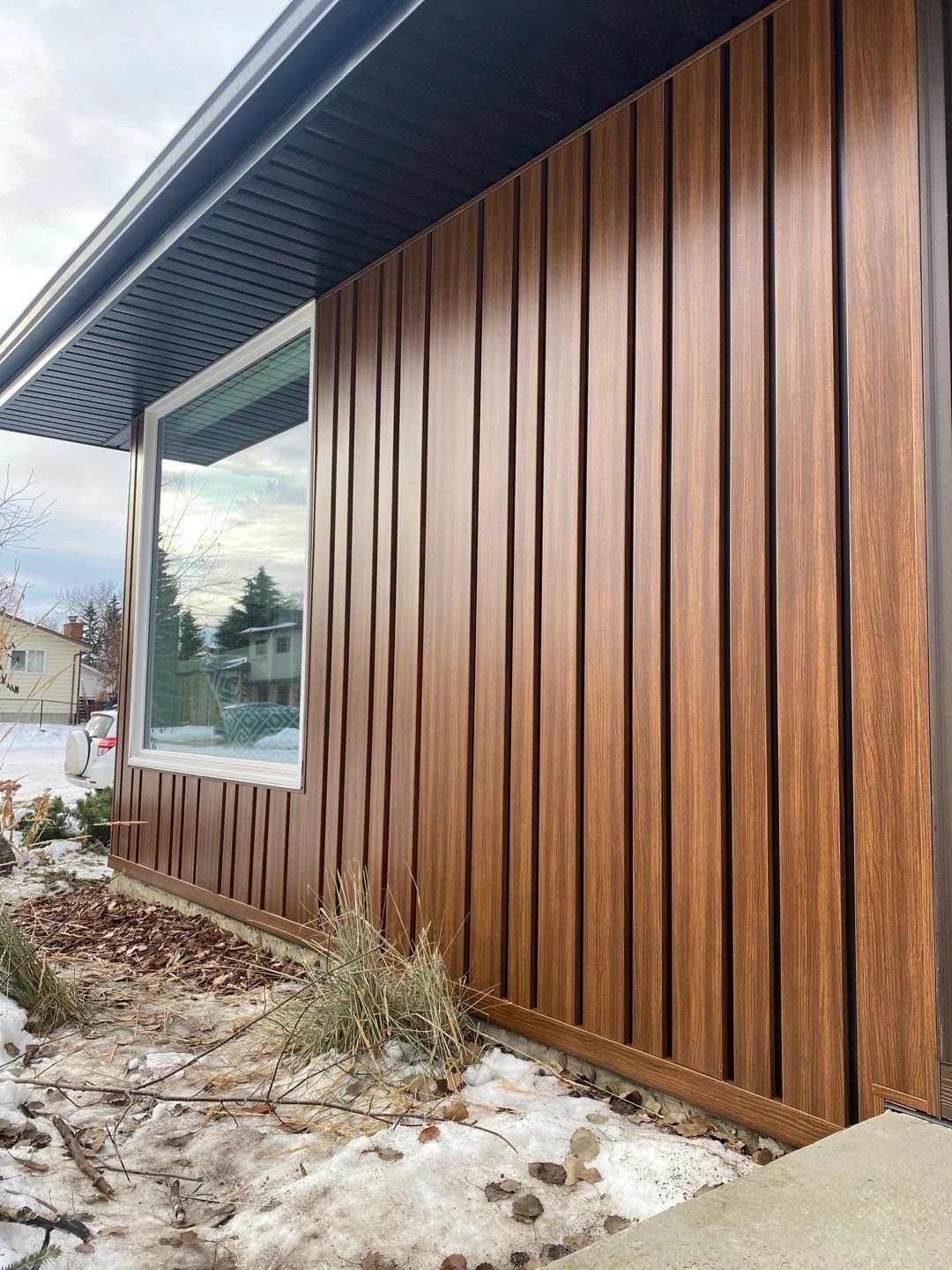
Authentic cedar siding and shakes have fallen out of fashion recently in Edmonton. It’s not because people don’t like the look; in fact, the look of stained wood is as on trend today as it’s ever been. It’s the constant maintenance that drives homeowners in a different direction.
That’s why the last 5 years and counting has seen massive growth in the use of “wood look” accent siding in the Edmonton siding market. These products offer a very compelling feature - the look of stained wood without the maintenance. If you love the natural look of cedar shakes or stained wood highlights on a house but don't want to be up on a ladder re-staining every other summer, doesn’t the idea of maintenance-free wood sound perfect?
As the “wood look” trend caught on, the number of wood siding alternatives in Edmonton grew significantly. Here’s a breakdown of the most popular “wood look” siding products in Edmonton, and a comparison to the cost of siding with a stained-look accent product.
Longboard
Longboard was the first wood siding alternative that really caught on in the Edmonton area. Made from super thick extruded aluminum, Longboard features a beautiful wood veneer protected by a clear powder-coated finish. The product first came to the Edmonton siding market in about 2012, and its popularity has grown every year. So far, we haven’t heard of a single example of a Longboard installation in Edmonton that hasn’t performed to the owner’s expectations.
Longboard is manufactured in 24-foot long planks, which can be installed horizontally or vertically. While Longboard is most popular for its woodgrain finishes, it’s also available in solid colours if those are a better fit for your design.
So, Longboard is a siding option that’s been tested in the Edmonton market, has a beautiful finish, and carries a great reputation - what isn't there to like about Longboard siding? As you might have guessed, the answer is pretty simple: the price.
Longboard is easily one of the most expensive siding products for residential use in Edmonton. The material itself is quite expensive (high-grade aluminum), but installation and shipping both contribute as well. Longboard needs all kinds of accessory trims. Longboard has corners, starters, base trims, top-of-wall trims, window and door surrounds, and a few other miscellaneous pieces. And each of these accessory pieces are ALSO super expensive.
Shipping and ordering rules are another huge problem with Longboard. Since local distributors don’t keep any stock on the product line, every order needs to be shipped from their manufacturing facility in British Columbia. Factor in the 24-foot long pieces and a sizeable minimum order quantity, and shipping costs can be quite substantial for smaller projects.
LUX Architectural Panels
Given the popularity of Longboard despite its high cost, it's no surprise that builders and homeowners in Edmonton started looking for alternatives for their designs. Lux Panel by Wayne Building Products is the closest comparable product, and it’s manufactured right here in Edmonton.
Wayne Building Products uses roll-formed steel to make Lux Panel, which is quite a bit less expensive than the aluminum stock that goes into Longboard. This allows Lux Panel to bring a similar wood look at a lower price point. Lux Panel looks a lot like Longboard, but will usually come in at about 33% to 50% of the overall cost of Longboard siding for a single-family residential project.
Shipping and ordering are other areas where Lux has an advantage. Because their manufacturing is all done in Edmonton, we don’t have to worry about minimum quantities, and lead times are easily manageable (3 weeks for most orders). As an added bonus, the Lux Panel product is available in custom lengths, so you aren’t stuck with 24-foot long pieces. For example, if you want to install Lux Panels as a 6-foot accent, you can order the siding cut to 6-foot lengths. This helps to reduce waste and boost efficiency on the job.
Lux Panel comes standard in a 4" wide and 6" wide reveal, with a classic V-Groove profile. Given its similar look and significant cost savings, Lux has been a growing Longboard alternative in Edmonton and is starting to make significant gains all over North America.
Sagiper
Sagiwall is another product that has popped up in Edmonton since Longboard took off a few years ago. And of course, the value proposition is simple and familiar - get the look of wood siding without the cost and maintenance!
Sagiper’s material differs from Longboard (aluminum) or Lux (steel). Sagiper is not made of metal but instead a corrugated PVC (vinyl). The material difference does give Sagiper its unique characteristics, but it's still similar to Longboard or Lux in its overall aesthetic.
Sagiper comes in two product lines - Sagiwall, its exterior siding product, and Sagirev, its soffit and interior siding product. Both products are now commonly used for siding Edmonton homes, and with a passing glance, it would be tough to notice the difference from Sagiper to Lux.
In terms of cost, Sagiper is very similar to Lux Panel. While Sagiper does bring significant savings over Longboard, it's still an expensive accent product relative to regular vinyl and fibre cement siding options.
Edmonton Siding Contractors: Who To Trust
Trying to figure out which contractors you should contact for your project can be difficult: there are over 40 siding installers listed on Google for the Edmonton area alone. If you check HomeStars, the Better Business Bureau, and the other half dozen or so listing services, you’ll find many more than that.
Is there really one “best siding contractor” out there? No, there probably isn’t. But there probably is one contractor that’s the best fit for you and your home.
The best place to start is the non-negotiable stuff, like licensing and insurance. Then you can start thinking about which finer criteria are most important to you and start choosing contractors from there.
Non-Negotiables
Here are a few items that any contractor working for a homeowner on a private renovation must have. If one of these is missing or expired, you should be extremely cautious:
Workers Compensation
You'll want to ensure that the contractors you consider have a WCB account and that it’s in good standing. The contractor must share their account number with you so that you can check with WCB to make sure workers on your site are covered as well. (And any company that has its stuff together should easily be able to send you a current WCB clearance letter that shows you this information).
There are lots of contractors out there that are behind on their WCB payments, or that simply have the wrong type of coverage. If someone gets hurt on your property and your contractor doesn’t have active WCB coverage for all workers, you could be held personally liable.
Business Insurance
Before choosing a contractor, ask them to provide you with a copy of their current insurance certificate. At a bare minimum, the contractor should be covered for double the resale value of your home. Most contractors carry either $2 million or $5 million in general liability insurance.
Licensing
If a siding contractor is going to discuss a project or present an estimate, quote, or contract at your home, they need a Prepaid Contracting License from the Government of Alberta. Do not pay any contractor a deposit for their work without first verifying their licence status. Not only is it illegal for contractors to solicit business in the home without this licence, but it also leaves the homeowner vulnerable to contractor fraud.
Homeowners are left with few options if an unlicensed contractor skips out after taking a deposit. A city business licence is not the same as a prepaid contracting licence.
Learn more about Alberta's Prepaid Contracting License here.
Positive Verified Reviews
One wonderful thing about doing contractor research in the 21st century is that the internet makes it super easy to find customer reviews. Here are a few of the most commonly used review sites:
Google is the most common review platform, because the reviews are super easy to post, and they show up right on Google, where homeowners usually go to do their research. Unfortunately, Google reviews are the easiest to fake.
The Better Business Bureau is a trusted name for homeowners, and their review platform is one of the most strict. Clients must be a confirmed customer of the contractor, and reviews disappear after 3 years - so you know that the reviews are reflective of the contractor's current service level.
Guild Quality isn't just a review – it's a total customer satisfaction survey taken either over the phone, or over email. Guild Quality reviews are always verified.
HomeStars reviews assign a score out of 10 based on your satisfaction with the company. Users must verify their email address, which adds a layer of authenticity.
When researching siding contractors, remember that there are lots of companies out there that mostly install roofing or window packages but also offer siding as a 3rd or 4th scope of work.
Make sure to read the reviews carefully to see if most of the 5-star reviews they’ve earned are actually for siding. There are some great roofers out there that turn in below-average siding work.
Most reputable contractors have good reviews from around the web, not just in one or two places. Don’t get fooled by fake reviews! Be wary of contractors with many glowing reviews on Google (where reviews aren’t verified) but very little with BBB or Guild Quality.
Essential Qualifications
Unlike mechanics or electricians, siding is not a ticketed trade in Alberta. In fact, the Siding Contractors Association of Alberta is still fighting to have siding recognized as a skilled occupation!
This means that siding contractors and installers in Edmonton are not tied to formal education or certification standards. You can’t just hire a “master siding installer” and trust that the job will be done right. As you continue with your research, here are a few qualifications to keep in mind that will help to make sure your project gets installed properly:
1) Product Experience
Different contractors focus the core of their business on different products. There are siding installers in Edmonton that have been doing vinyl siding for 20+ years and do a wonderful job of it. However, when asked to install Hardie Board, they lack the knowledge, skill, and proper tooling to do it correctly. The opposite can be true as well.
Ask all contractors you are considering for recent examples of work with the products you are looking at. They should be able to provide photos and addresses of recently completed work.
2) Experience With Homeowners
As we mentioned above, there are dozens of siding contractors in Edmonton (maybe even 100 or more if you spent the time to comb through all the lists). Most of these contractors spend more than 90% of their time working on new construction or multi-family projects with home builders or general contractors. Working for a homeowner on a renovation project is entirely different, so check to make sure the contractor has a dedicated point of contact that only deals with renovations.
3) 3rd-Party Certifications
Certifications and accolades aren’t everything, but generally speaking, they can be a good indication that a company is at least established and reputable.
After all, these days it’s not all that tough to make a nice-looking website and start advertising online.
For example, Blue Jay Exterior Renovations is an Elite Preferred Contractor with James Hardie Building Products.
We are also a member of the Siding Contractor’s Association of Alberta, and have been accredited by both the Better Business Bureau and the Baeumler Approved program. That’s one manufacturer accreditation, one trade organisation, and two consumer advocates.
Each of these certifications comes with its own set of qualifications and responsibilities and shows that we are serious about our reputation.
Elite Preferred Contractor Badge
A manufacturer program affiliation is just one type of 3rd party accreditation
4) Contractor Badges
While we are proud to be an Elite Preferred Contractor from James Hardie, this is just one type of essential qualification. Don’t be fooled by the guys who flaunt badges but lack the above qualifications.
When entrusting a contractor with your home, they need to come with the full package of proven reliability – not only a manufacturer badge.
Customer Experience
Proper siding installation is really just the beginning. Considering these factors will help to ensure that the project matches your vision, and doesn’t raise your stress levels through the roof during construction.
1) Communication
According to Guild Quality (a homeowner satisfaction survey company) poor communication is the #1 reason for homeowners to dislike their contractor.
Luckily, the consultation and quoting process gives you lots of chances to test how a company communicates. Watch the response times, forms of communication, and quality of communication when you are in the quoting stage. Does the contractor respond quickly to your questions? When communicating in writing, do they write clearly and professionally? Or is there EMAIL ful of typos + speling porblems? Do they respond using the method you used to reach out? (This may sound like a small thing, but if you are trying to get someone on the phone and they only respond with emails and text messages, it can get incredibly frustrating).
If the contractor isn't able to make your initial meeting on time, is slow to respond to your questions, or doesn't effectively explain the design to you, you can expect this to carry through the whole job. After all, measuring and quoting the job is supposed to be the easy part!
2) Process
Giving an estimate, signing a vague contract, and showing up on site to start work in “2 to 6 weeks” doesn't cut it. Your contractor should be able to show you a clear, written process for payment terms, design checklists, installation reviews, progress inspections, and communication. The best siding contractors follow strict processes designed for homeowners that ensure a consistent, positive customer experience.
3) Pricing
Just like most things in life, the best price on siding doesn't always mean the best deal. Re-siding can be expensive, and affordability and budgets should absolutely be a factor in your decision. Just make sure you weigh the other factors when taking price into consideration. Beware the low bid: after all, it costs less to do the job wrong.

Edmonton Siding Renovation Cost: What To Expect
Here’s what you should expect to pay for a siding replacement project in Edmonton (this has been updated for 2025). Just like asking what the price of a car is, the cost of a siding renovation varies depending on a number of factors. If you want a big SUV with all of the upgrades, it will cost a lot more than a compact car with no AC and a manual transmission.
First, we’ll lay out basic per-square-foot pricing for each main product. Please remember that these approximate costs reflect the supply and installation of your siding, including accessories such as weather barriers (Tyvek), fasteners, appropriate trims, and flashings to keep moisture out, etc.
● Vinyl Siding Cost – Standard colour - $11.00-13.00/sqft, dark or premium colours - $12.50-14.50/sqft
● James Hardie Siding Cost (Includes Trims) – $22.50-27.00/sqft
● Wood Look Accent Cost – $70-120/sq. ft
● Panelized Or Manufactured Stone Accent Cost – $60-100/sq. ft
To come up with a budget, you'll next want to figure out the approximate square footage of your walls. Siding is generally priced in dollars per square foot of wall ($/sqft). We’ll give you a few basic house types with a budget square footage to get you started, but measuring your exact home will give you a better idea. And if you want us to give you a quote that’s 100% price guaranteed, those are always free.
Common Edmonton Home Models:
● Standard Bungalow – 1,050 to 1,250 sqft
● Split-Level – 1,400 to 1,750 sqft
● Two-Story Attached Garage – 2,100 to 2,600 sqft
● Two-Story With Walkout Basement & Attached Garage – 2,800 to 3,600 sqft
NOTE: If you’d like to calculate your own home’s square footage a little more precisely, add up each wall’s square footage using the following formula: (wall height X wall width) – total window area = wall footage. For triangular walls, such as roof gable ends, use the same formula but divide the resulting wall footage in half. This works for regular triangles only, not asymmetrical ones. For walls with irregular shapes, try to break it up into squares, rectangles, and regular triangles. Then calculate the footage of the shapes within the wall and then add them all together. You might have to use some trigonometry to measure some of the taller walls!
Now that you know approximately how much square footage your home has, we can start building your budget. Most of the time, we start with removal.
The type of exterior siding you must remove makes a big difference in the cost. For vinyl siding, budget $2.00/sqft for removal costs. For wood or metal siding, budget $2.75/sqft. For stucco, we’d recommend a budget of $7.00/sqft. Each budget includes costs for a disposal bin company to take away the waste. Stucco is by far the highest cost, in part because of the extra work to remove it, and in part because the weight of the material requires more bin dumps.
NOTE: We don’t always have to remove your existing siding or stucco, but it’s usually a good idea. Check out our article about installing Hardie siding directly over existing stucco, which can usually save you money. Installing vinyl siding over older wood siding or stucco is usually even more straightforward. If you’d like to find out if your home is right for installation over old siding or stucco, please contact us so we can discuss your project in a little more detail.
Here are a few worked examples of budgetary pricing using the information up above (please note that GST is not included in these prices. Please also note that removal costs include supply and installation of new weather barrier, as well as necessary flashings, vents, electrical, and items such as house numbers and mailbox):
Model 1) Standard Bungalow
+ Remove vinyl siding: $2,100 to $2,500
+ Remove wood siding: $2,900 to $3,500
+ Remove stucco: $7,350 to $8,750
+ Install vinyl siding, standard colours: $11,550 to $16,250
+ Install vinyl siding, premium or dark colours: $13,125 to $18,125
+ Install HardiePlank siding: $23,625 to $33,750
Model 2) Split-Level
+ Remove vinyl siding: $2,800 to $3,500
+ Remove wood siding: $4,000 to $5,000
+ Remove stucco: $9,800 to $12,250
+ Install vinyl siding, standard colours: $15,400 to $22,750
+ Install vinyl siding, premium or dark colours: $17,500 to $25,375
+ Install HardiePlank siding: $31,500 to $47,250
Model 3) Two-Story With Attached Garage
+ Remove vinyl siding: $4,725 to $5,850
+ Remove wood siding: $6,100 to $7,500
+ Remove stucco: $14,700 to $18,200
+ Install vinyl siding, standard colours: $23,100 to $33,800
+ Install vinyl siding, premium or dark colours: $26,250 to $37,700
+ Install HardiePlank siding: $47,250 to $70,200
Model 4) Two-Story With Walkout And Attached Garage
+ Remove vinyl siding: $5,000 to $7,200
+ Remove wood siding: $8,000 to $10,000
+ Remove stucco: $19,600 to $25,200
+ Install vinyl siding, standard colours: $30,800 to $46,800
+ Install vinyl siding, premium or dark colours: $35,000 to $52,200
+ Install HardiePlank siding: $63,000 to $97,200
As you can see, the budget ranges can be wide. This is mostly due to the square footage ranges that we’ve allowed for, but there are other factors that influence the price as well. Here are a few to consider:
Type of products – These price ranges account for horizontal siding with market standard accessory trims, and an average amount of accent products. Adding in more design accents (such as board and batten. shingle panels, or masonry) could increase the price even beyond our upper budgetary limit.
Size of project – In general, per square foot budgetary numbers get less accurate for smaller projects. If the project is for less than a full house exterior, please contact us for more accurate budgetary pricing. For example, pricing per square foot on the front facade of a home only will be significantly higher than these ranges.
Unique quirks – We’ve given you budgetary ranges for each of these products because no two renovation projects are ever exactly alike. Some seemingly small factors that could influence the price even further include: hose bibs needing to be changed, fence posts being too close to the wall, soffits covering the existing siding, a second layer of original siding or stucco hidden away under a top layer, and countless others.
Details of the project – Does the house have long flat walls with few openings, or are there lots of windows and accents breaking up sections? Are all the corners 90 degrees, or are there other angles?
Trims – Are the doors and windows on the whole house going to be trimmed, just the front, or none at all?
Soffit/Fascia/Eavestrough – Were you hoping to update or replace your existing eavestrough system or your soffit and fascia? Soffit, Fascia, and Eavestrough are something we commonly do as part of our projects but in most circumstances don’t have to be done at the same time as the siding.
Insulation – Are you considering adding exterior insulation as part of your project? If so, how thick? Sometimes, adding insulation will require structural wood strapping.
We hope you found this information helpful! We’re happy to be a part of your renovation journey - whether that’s simply providing some information online, answering some questions at the showroom, or giving you a free consultation.
As you continue to do your research, or if you still have more questions, please feel free to contact us and we'll be glad to help. Send us an email, or give us a call! Or reach out via the form below. And thanks for reading!