
How Much Exterior Insulation Should You Add To Your Home In Edmonton?
Get the most “bang” for your insulation buck.
“How much exterior insulation should I add to my walls” is a super common question for homeowners in Edmonton. The answer is almost always “it depends”, of course. But there are a few factors we look at with our clients to help guide them in the right direction.
Here are a few things to think about as you plan your project:
Before we begin: here’s a very quick definition of R-value, because having an understanding of this term will help you read the rest of this article. Basically, R-value is what we use to explain how well a material resists the transfer of heat. If a material has a higher R-value, heat takes longer to pass through, and it’s a better insulator.
How much insulation are you starting with?
First things first. Does your home really need more exterior insulation? That’s going to depend largely on its current R-value.
The current Alberta Building Code requires the R-value of above ground exterior walls of all new homes to be at least R22. But the vast majority of homes in the Edmonton area fall well short of today’s code.
From the 1950s through to the early 2000s, standard framing for home building was a 2x4 wall with fiberglass batt insulation. In the best case scenario, this type of wall will give you R12 of insulation value. If there are extra 2x4s in the wall, or if the builder didn’t do a perfect job of insulating between every single stud, your true number might be closer to R10.
While we don’t necessarily believe that every single house needs to have an insulation value that meets current code, it does make sense to use the code number as a general guideline. After all, the Alberta Building Code is put together by building scientists to give builders and contractors a standard of good construction and healthy home building that’s tailored for our unique climate.
If you’ve already got R20 or above in your walls, you won’t get as much value out of an insulation upgrade.
But if your home was built before the year 2000, you’ve probably got somewhere between R10 and R12 in your walls. And that just doesn’t cut it in Edmonton.
After you’ve figured out how much R-value you’re starting with, the next step is to come up with a budget for insulation upgrade.
How much do you want to spend on exterior insulation?
If every client had an unlimited budget, then everyone would choose a massive 3” layer of insulation and look forward to an R14.1 insulation upgrade of their exterior walls. But most of our clients do have a budget, and an entire financial plan that their exterior renovation needs to fit into. (Blue Jay doesn’t work on government projects where 40% cost overruns are just another day at the office.)
So for most of our clients, we’ll give quotes for 2 or 3 different insulation thicknesses. This way, you can compare the cost and the benefit of a few different options, and settle on the right upgrade for your home.
When choosing the exterior insulation thickness for your home, there’s an important break point that will have a major impact on your budget. For James Hardie fiber cement siding, that break point comes at 1” of insulation. For vinyl siding, it’s 1 5/8”.
These numbers are important because that’s how thick an insulation layer can be before we must add wood strapping to the wall assembly. If we try to install Hardie board over a layer of 2” insulation without strapping, the nails won’t be strong enough to hold up the siding. Eventually all the boards will sag, or even fall off completely.
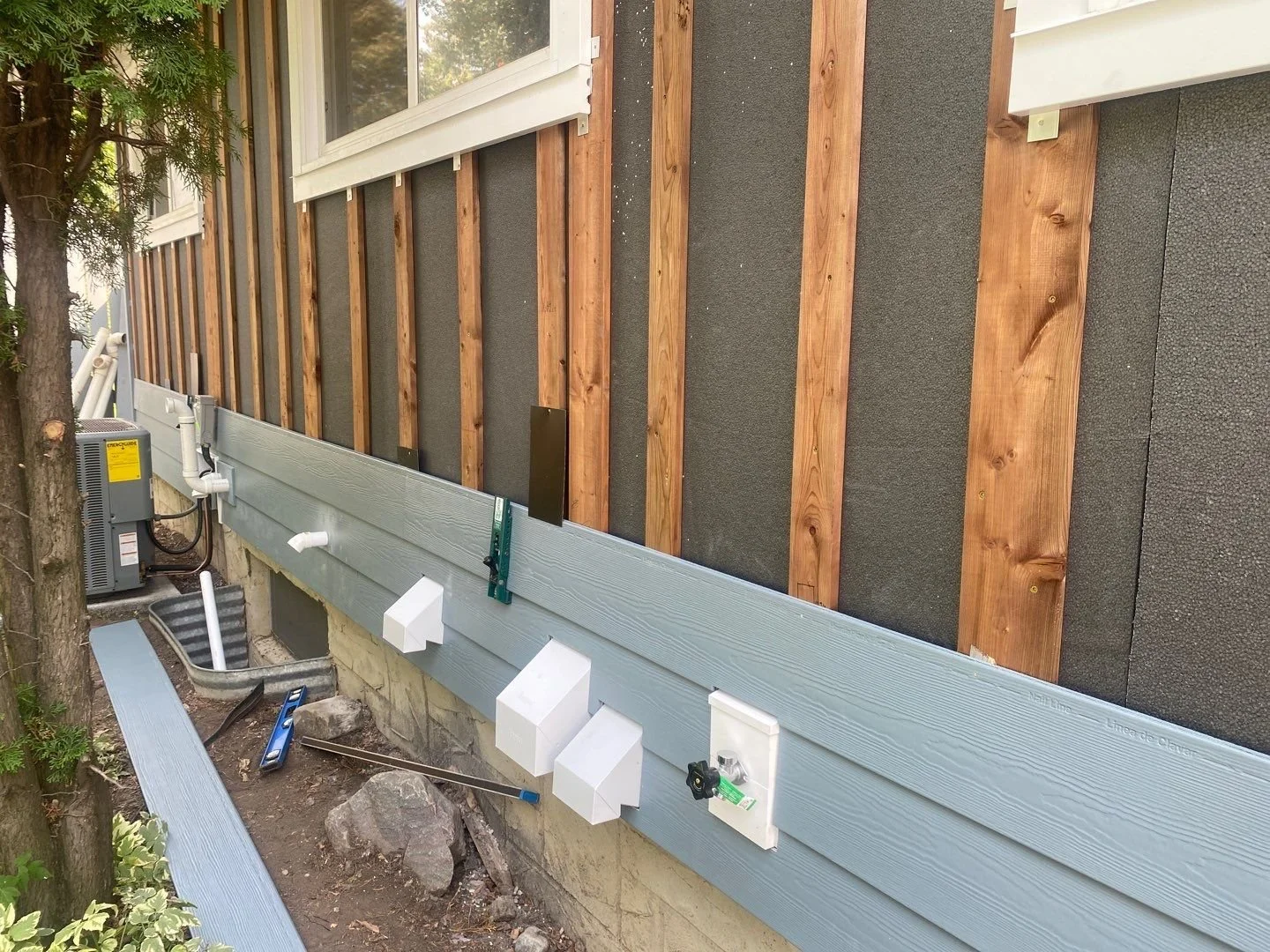
For thicker layers of exterior insulation, structural wood strapping must be installed to create a solid layer for fastening the siding.
The Cost Of Exterior Insulation In Edmonton.
So, we’ve figured out how much R-value your exterior walls have to start with, and we’ve established some basic guidelines about price points for different insulation thicknesses. Now we’ll try to put that all together with a real-world example.
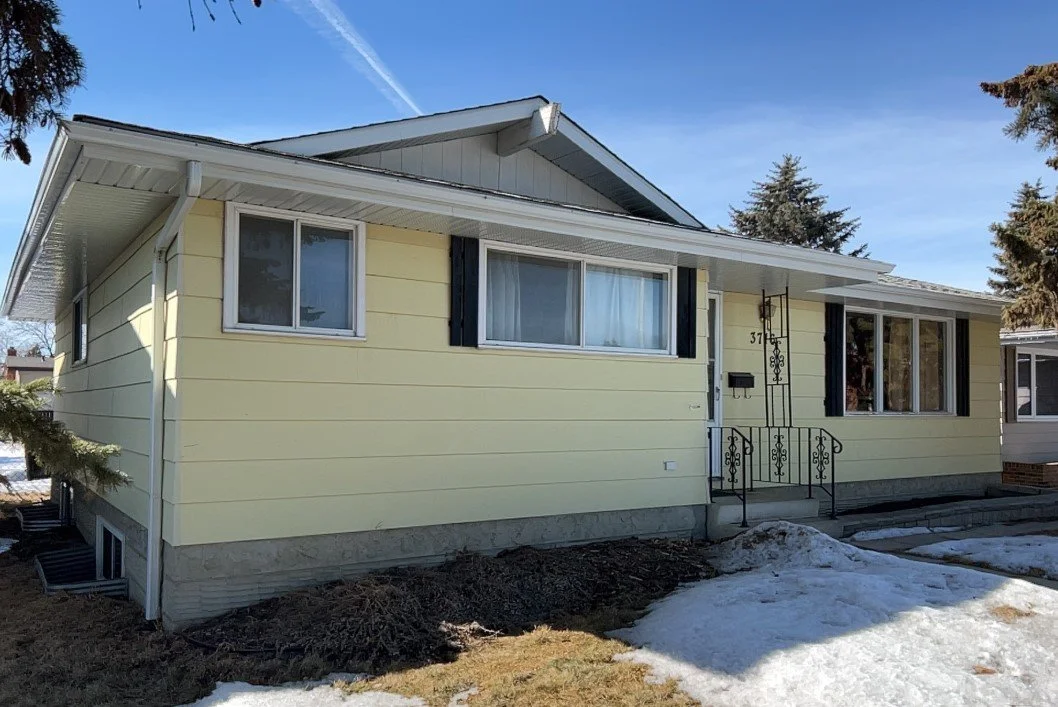
Here’s the “before” picture of a bungalow that Blue Jay worked on in 2024. It’s got a relatively small amount of footage on the exterior walls - we measured 913 square feet of siding. (This home has a hip roof with only a small dutch gable in front - which really cuts down on the amount of wall footage.)
Using the measurements for this home, I’ll work up some quick pricing options for both vinyl siding and Hardie board. This way, you can get a good idea of how different levels of insulation can change the price of a project, and how much R-value you can expect to gain.
For all packages with vinyl siding and Hardie, we’ll include removal of the original metal siding, new Tyvek with peel & stick at the windows & doors. I’ll also include 3.5” trim boards at the windows and doors, to make it more of an apples-to-apples comparison.
Since this house is built with 2x4 walls, we’ll assume an R12 insulation value to start with. Insulation packages will be specified with EnerSpan, our preferred insulation option.
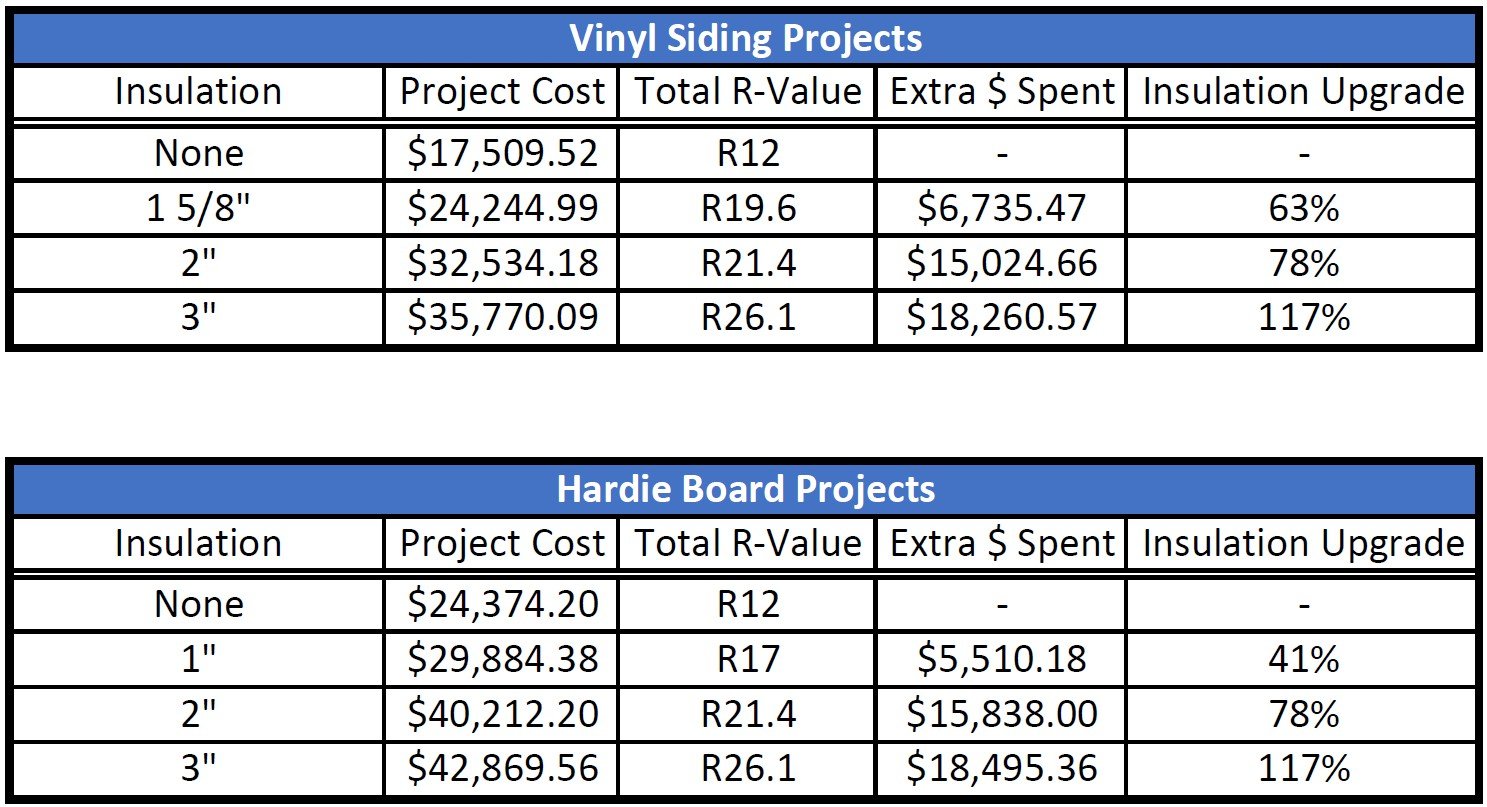
The Cost of Exterior Insulation with Vinyl & Hardie Siding
**Please note that these numbers are intended for general guidance only. Every house is different, so every exterior renovation is different! To get an accurate price for your home, please contact us for a detailed quote that’s guaranteed to be on budget.
The main takeaway that we can see from these numbers is that for both Hardie and vinyl siding, moving up to a package that includes wood strapping adds quite a bit to the cost of the project. But once you’ve crossed that threshold, adding even more insulation becomes very cost effective!
Conclusion: Choosing The Right Amount Of Exterior Insulation.
So, how much exterior insulation should you add to your siding renovation? Like we said in the intro, it depends!
If you want to add a ton of R-value to your wall at the lowest possible price point, 1 ⅝” insulation with a vinyl siding exterior might be the right choice for you. But if you’ve got a plan to stay in this house for the rest of your life, and want to make sure that you’re comfortable as you age in place? Hardie siding with an ultra-efficient 3” layer of insulation might be a better long-term value.
If you’re starting to think about an exterior insulation upgrade for your home, now is the perfect time to get your free quote from Blue Jay Exterior Renovations. Even if you don’t think you’ll be ready to start the project for at least 1 to 2 more years!
At Blue Jay, we only work for homeowners, and never for home builders. We understand that our clients probably don’t know how much to budget for a siding project. And if you don’t know how much to budget, how are you supposed to make a plan to save up?
Blue Jay’s quotes always come with absolutely zero sales pressure, are 100% percent guaranteed to be on budget, and are valid for 6 months. So you can feel comfortable using us as a resource to plan your project: ask us questions, get our advice, and visit our one-of-a-kind Warehouse Village showroom. And if you don’t end up hiring us for a project, there’s no hard feelings at all.
That’s what we’re here for!