
4 Things to Know About Using CEIP for an Exterior Insulation Upgrade
As a CEIP qualified contractor for the Edmonton area, we have enjoyed working with and helping guide several clients through exterior renovations as part of the Clean Energy Improvement Program. The only active energy efficiency program in the area today, it can be a wonderful means of getting you the comfort/efficiency you’re seeking for your home today, while allowing you to pay for it over time at a reasonable interest rate.
While there are a lot of benefits to pursuing the program, there are several considerations to know before pursuing it for an exterior renovation.
Here are four things we like to let every client know early in the process when using CEIP to add exterior insulation to their home:
It is not a quick process
Working with CEIP, even after being pre-approved, is a slower process than most of our customers expect. The quickest signed contract we’ve seen on a project from submission (done by the homeowner) to a signed contract between us, the municipality (in this case, Strathcona County), and the homeowner, was 70 days. And that was with a customer that was pre-approved, extremely responsive, and very on top of their paperwork. As an aside - you can always expect to hear back from us within 1 business day of reaching out (whether actively working for you or after your project is completed), so we’ll seldom be the delay in your process.
We worked on another project where the gap from project submission to signed contract with the municipality (in this case, Edmonton) was 205 days!
After getting your quote, if you let us know that you’d like to proceed with the work we’ll put you into our production schedule at that point - even without the signed CEIP contract. So you’re not waiting for the contract signature to get into the queue, but we would want to make you aware that if you were planning on having the project completed within a couple months of committing to the work, it probably isn’t in the cards with CEIP at this point.
One thing to consider with timing on CEIP projects as well is that you’ll need to take on a minimum of 3 CEIP projects. Typically that would include something like attic insulation and windows. If you’re planning on doing windows as part of your CEIP project - you’ll want to plan for the work being spaced out even more from your original project submission. The windows won’t be ordered until you’ve got a signed CEIP contract - and then you’d typically be looking at 6-12 weeks from there for the windows to be made/installed.
There is some hope for timelines to improve though - when the Greener Homes Program was running (a former federal energy rebate/loan program) we saw a drastic improvement in approval/processing timelines as the program went on. CEIP has been around a few years now, and we would expect it will continue to improve as it goes on. If you’re reaching out for a CEIP quote, feel free to ask us what we’re currently seeing today so you can get the most up to date information.
2. You’ll typically be adding more exterior insulation to your assembly than you might otherwise
Each energy rebate or loan program we’ve worked with has had its own set of rules for how much exterior insulation is required. While some (such as the Greener Homes Loan) had a specific R value they wanted you to add regardless of what was in you walls currently, CEIP is looking for a total R value (inclusive of what is there currently).
Specifically, CEIP is looking for the R value of your main walls to reach a minimum of R21. This is a great number to reach, and will certainly alleviate issues you might be having in an older home, like frost building up along baseboards/corners, cold spots on certain walls/bedrooms, or an AC unit that seems to be running full time every Summer. But for a lot of our clients, it’s more than what is needed to make an effective change, and the cost implications of getting to R21 might put the project out of reach.
If you’re in an Edmonton area home built prior to the late 80s, you’re likely in a home with 2×4 construction. Those homes would have been built to an R12, and the energy audits we see would show these are now typically performing around an R10 or R11 as the insulation has settled over time. So to go from an R10 or R11 to an R21, you’re of course looking at adding an additional 10-11 of R value.
That’s completely feasible and something we’ve done many times - but moving from an R5 or R7.6 insulation upgrade to an R10 or R11 might add anywhere from $5,000 to $15,000 to your project - and that extra 2.5 or 5 R value might not be worth it.
There are actually a lot of considerations as to how we would assemble your wall with exterior insulation (including the type of siding being installed over it, whether we’ve removed everything and gone back to sheathing or are going on top of an existing product like stucco, etc.), but generally an add of R5 or R7.6 (1” or 1.625” of our favourite insulation product, respectively), will not require wood strapping (pictured below). Wood strapping, the process of attaching pressure treated wood on the outside of your new insulation with structural screws into the existing studs, is something we do - but it brings with it a large added cost.
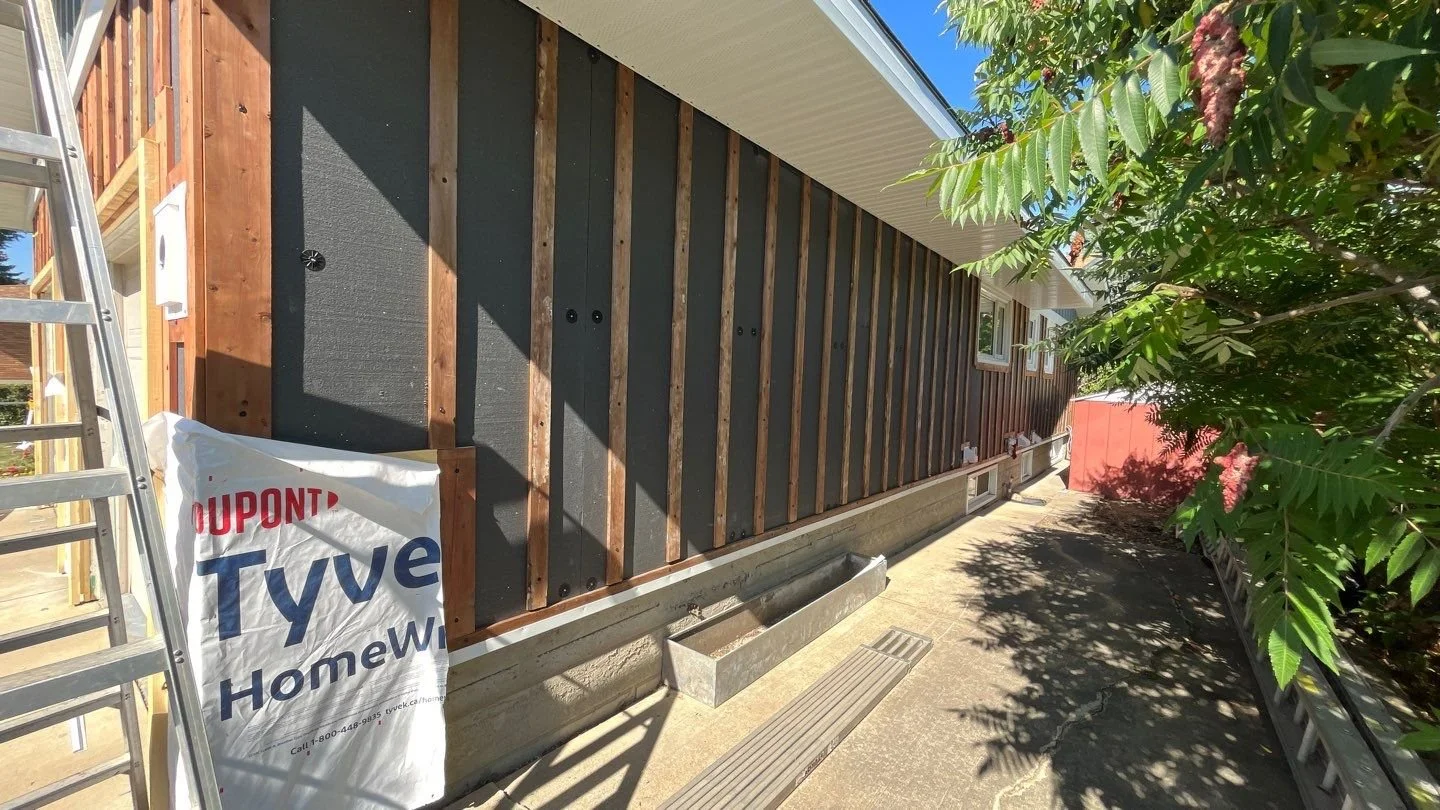
Wood strapping installed over top of exterior insulation
Again - there are scenarios where we’re going to be adding strapping as part of the assembly regardless (if installing Hardie siding over top of stucco, for instance), but if you can avoid it you’re saving thousands of dollars. The added R value of moving up to an R21 will absolutely be a welcome change and a significant energy improvement. But we’ve done enough exterior insulation projects locally to know that you can have a major impact with less.
This project below is an early 80s home where we removed the original wood siding, updated the original weather barrier and added a peel and stick membrane, and installed a 1” (R5) layer of Enerspan Insulation, as you’ll see in the photo below.
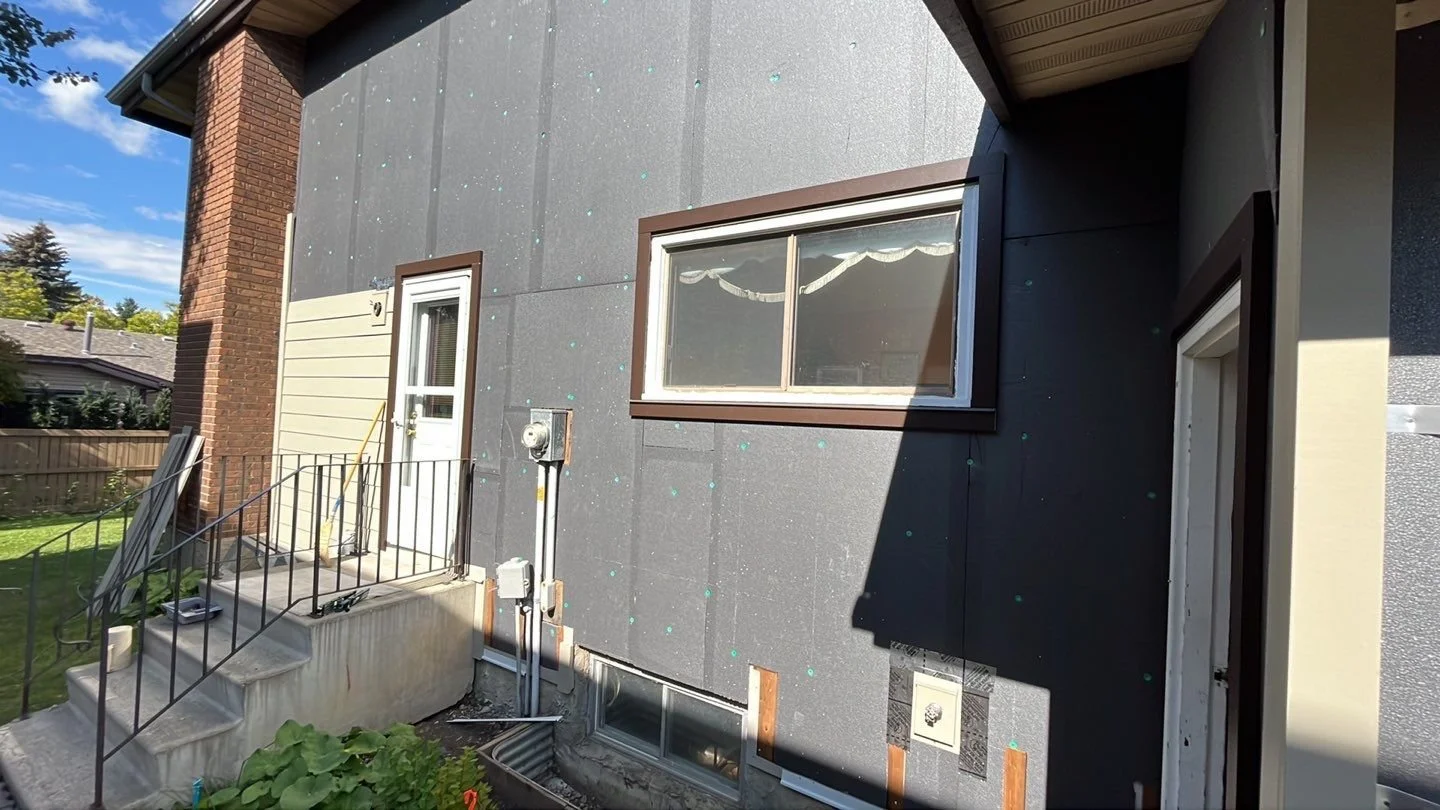
We worked on a home across the street a year later, and got to chat with this homeowner while working in the area again. They had a 25% reduction in gigajoules with that R5, and no windows were replaced in the process or other changes made. That’s a significant improvement in energy efficiency and comfort with a smaller insulation and no strapping - and it makes sense. While we didn’t hit R21 with the new insulation, we did increase the existing insulation from an R10 or R11 by anywhere from 40-50%, and we did so while installing that insulation in a continuous layer - no thermal brakes or cold spots on the wall.
We installed an R7.6 (1.625”) insulation over top of the existing stucco on this home pictured below as part of the Greener Homes program. The homeowners also had the windows replaced at the same time (we coordinated on the window buildouts for this project).
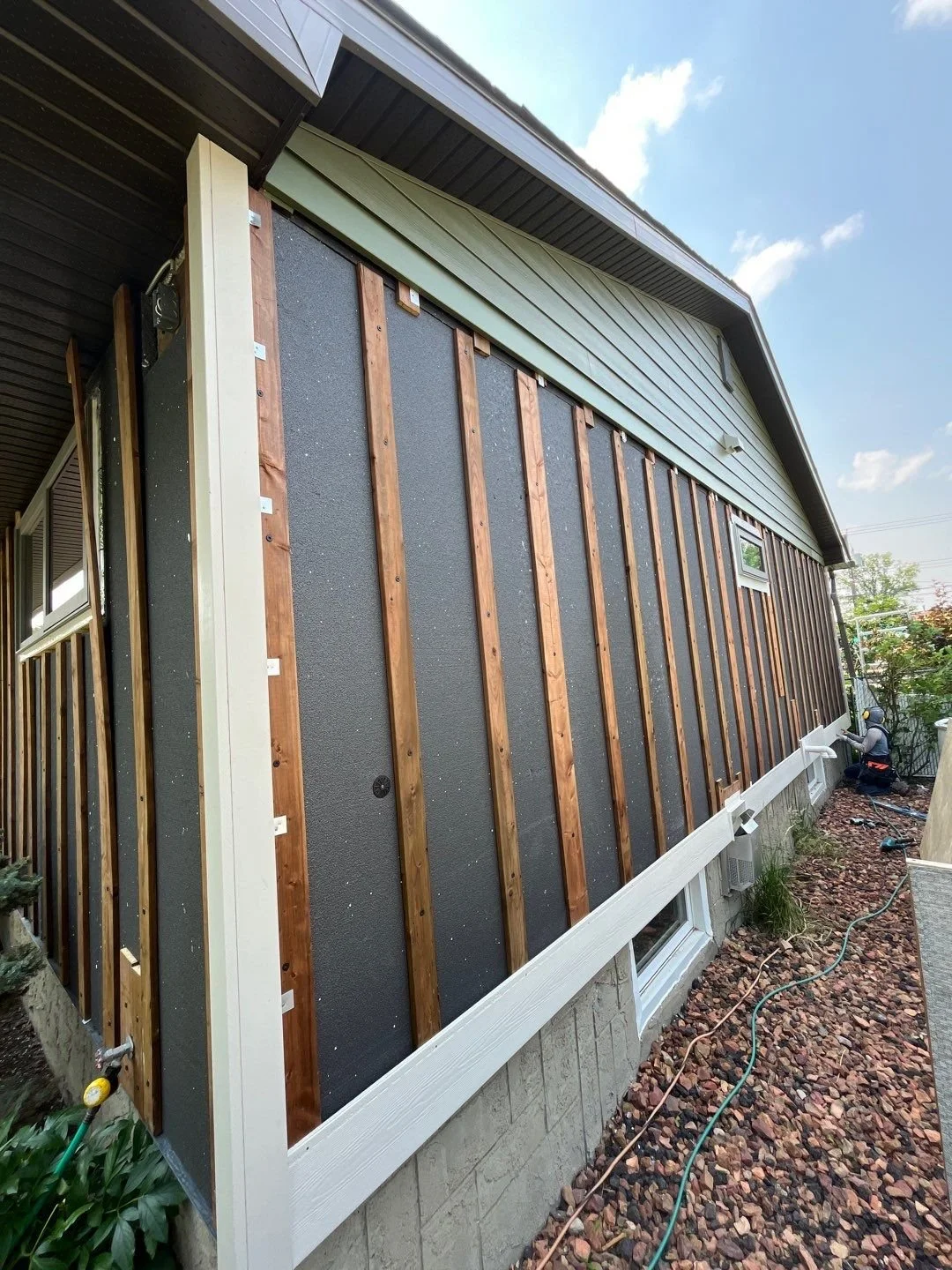
The homeowner was nice enough to call us that Summer, during a heat wave, to share some good news. Despite the 30+ degree weather, it was 10 degrees cooler inside the home than outside. Even more impressive - they don’t have AC!
It’s not to say getting your home up to an R21 is a bad thing - quite the opposite. Exterior insulation is an effective means of making your home more comfortable and increasing energy efficiency. But the exterior insulation we add on a CEIP project and the typical cost associated with that means they’re on average more expensive renovations than our non-CEIP insulation projects.
When you get a consultation, our team will make sure you know all your options, so you can make an informed decision on what the right package is for you.
3. You’ll have to take on 3 different energy improvement projects
CEIP will require you to take on a minimum of three different energy improvement projects as part of the program, with very few exceptions. So unfortunately if you were just planning on addressing your exterior insulation, you’ll have to add on a couple other projects to take advantage of the program.
There are a couple exceptions (if you’ve already used CEIP for the same property, or your energy assessment shows that less than three of the upgrades will get your home to net zero), but we’ve not come across these scenarios at this point. For most of our clients hoping to take advantage of the program, that will mean adding scopes.
4. CEIP won’t cover the full amount of your exterior renovation
While adding exterior insulation will require some fairly significant incidental costs (including the supply and install of the siding and pressure treated wood strapping), not all incidental costs are covered. At this point, we still aren’t 100% clear on what percentage or dollar amount of your project will be covered by the CEIP program and what will have to be paid out of pocket, but our most recent project had the homeowner covering roughly 60% of the costs associated with the project.
Receiving 40% at a reasonable interest rate through a long term government program is a fantastic thing, and can help you get closer to your energy efficiency and comfort goals sooner than you might be otherwise - but with the R value reqiurements of the project, you’ll still be paying a large amount out of pocket.
The reasoning for this is likely two fold - one, the CEIP is set up to provide homeowners with fuding to use towards energy improvements, and a lot of the cost on an exterior renovation like this is incidental, but not strictly going to imrpove the energy efficiency of the home. The second being that the funding for CEIP at each municipality is being utilized, and limiting spend per property is allowing them to service more homeowners. It doesn’t necessarily help you with your CEIP exterior renovation, but it is the reality of the circumstance.
If you’re interested in pursuing energy upgrades as part of CEIP, you can check out the availability for your municipality below:
Clean Energy Improvement Program
And if you’d like to get started with a consultation on costs and options for your exterior renovation (as part of the program or otherwise), reach out to us today!